 HRISTMAS
  ISCONCEPTIONS AND YTHS
There are a lot of common misconceptions or plain old errors that have been accepted as fact since Christmas was first celebrated in the Fourth Century. These are myths that are associated with the Biblical aspects of the celebration that have been retained in modern tradition. In an effort to clear up these misconceptions and myths, and not to spoil the fun, some of what has been revealed by scholars as the either truth or educated speculation is listed here in brief for two of them.
December 25, 1 A.D.: The actual month and date of the birth of Jesus Christ is, of course, unknown. However, comparisons with historical records of current events noted in the Scripture, such as Herod's edict to have the first born of Israel killed, put the year as possibly 3 or 4 B.C., some time before the accepted 1 A.D. The birth was most likely in the spring, not December, as this is when taxes were collected and when shepherds were out in the field at night during lambing season. December 25 was a Pagan holiday of the Winter Solstice for followers of Mithras, a Persian sun god. This sect was the chief religious rival to Christians in Rome late in the fourth century. The Romans also had a celebration during that time called Saturnalia, honoring Saturn, the god of agriculture. When Emperor Constantine accepted Christianity for himself and later outlawed paganism in 392, Pope Julius suggested that the annual recognition of the birth of Christ be celebrated at that same time so that the old holidays could be absorbed into the new one. By the end of the fifth century, the celebration of Christmas on December 25 had taken hold, as had Christianity throughout much of the known world.
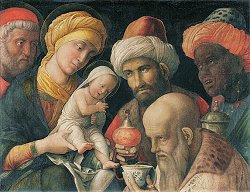
The Magi: Known often as kings, but in reality more likely scholars and astronomers, the Magi or Wise Men traveled from the east, which could include modern Iraq, Iran or Turkey, and possibly as far as Pakistan.
Magi is derived from the Persian word for
Magician, and they were considered members of a priestly caste of Persians. Nowhere does the Scripture say there were three of them, a number that was settled on in the sixth century to coincide with the three known gifts of gold, frankincense and myrrh. There may have been many more than that, and early depictions of the Magi in catacombs vary in the number of them. They also did not likely arrive just after the birth, since such a journey and the meetings with Herod would have taken considerable time. The Scripture notes that the star they were following (seen as a miraculous anomaly to astronomers of the time) had settled over the house where Jesus lay, which means they could have arrived many months after the holy birth at a house in Bethlehem that Joseph had temporarily secured, rather than the commonly celebrated 12th day of Christmas, January 6, also known as Epiphany. The names assigned to the Magi,
Melchior,
Gaspar or
Caspar (frequently portrayed as black) and
Balthazar first appeared in the 7th century. Surprisingly, it was a rector of Christ Church in Williamsport, Pennsylvania,
Dr. John H. Hopkins, who fanned the flames of the myth even further when he composed the famous carol
We Three Kings in 1857.
 HE
HE  ICKENS,
  OU
OU  AY?
AY?
There is hardly anybody that has reached the age of ten in the Western world that does not know of the short story written by London's literary favorite, Charles Dickens, titled A Christmas Carol. Yet with the number of films and television shows made of this story, there are still some common misperceptions about its creation and some of the story content, which is sometimes dismissed for the sake of a secular audience in a time and place far removed from Dickens' London of 1843. In the hopes of distilling some of this information into renewed interest in actually READING the book (links at the end) instead of just watching it, and explaining its growing popularity by the Ragtime era, here are novel facts about the man and his worthy tome.
It was more than whimsy or creative muse that motivated the author of hefty volumes such as
Charles Dickens
c. 1860s.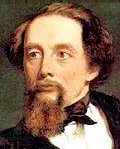 |
A Tale of Two Cities and
David Copperfield to concoct this short but cherished Christmas story, which is the best loved and most read of all of his writings. Ironically, as might be well attributed to the primary bane of the protagonist of the story, it was money. In the fall of 1843 Mr. Dickens and his wife Kate were expecting their fifth child. Famous as he was at the time, many of his friends and family were under the impression he was made of money and made no bones in asking for some of it. He also had a large mortgage on his Devonshire Terrace home, and his latest serial novel,
Martin Chuzzlewit, was not generating income, leaving the author short on funds. So he sat down to write something short and sweet that would be sure to have both appeal and merit, selecting the spirit of Christmas as the topic. Much as
Ben Hur would later convert its author,
Lew Wallace, to Christianity, Dickens was so consumed by this book that seemed to write itself that he became emotionally intertwined with the story. This included mood swings from laughing to crying, and many long contemplative walks through London well after dark trying to soak in the environment.
Once Charles was satisfied with the final draft, he approached his wary publishers who were non-plussed based on the brevity of the book as well as current sales of his prior works. Dickens so believed in this story that he paid for the production cost of the book himself, creating an initial edition with lavish design that included a gold-stamped cover and four hand-colored lithographs within. He then proceeded to price the product at a mere 5 shillings (1/4 pound) in hopes of drawing a larger audience not usually prone to purchasing books. The first printing was made available the week before Christmas 1843, and word of mouth helped it to fly off the shelf quickly. However, as a result of merchant discounts and extravagant production costs, the author's earnings were lower than expected. To add to his misery (motivation for David Copperfield, perhaps?) pirated editions of the popular story quickly appeared throughout England. Understandably a staunch supporter of copyright laws which were poorly enforced in England and rarely recognized outside of the island, including in the United States, Dickens fought these rogue publishers as best he could, but ended up spending more in defense of his rights to the book than he was making from the property itself.
As with the ghosts in the famous story, Dickens enduring efforts eventually paid off, and he became ever more popular and wealthy during his lifetime, which ended at the age of 56 in 1870.
Ebenezer Scrooge at his moment of epiphany and repentance.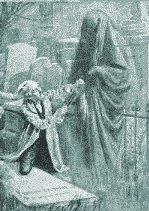 |
Dozens of stage plays, radio and television presentations, and movies of all sizes with distinguished actors have been produced of
A Christmas Carol, perhaps more than with any one story, save those of the child whom we remember on Christmas day. A diversity of famous stage and screen actors have long sought to put their own take on Scrooge, including
Lionel Barrymore,
Basil Rathbone,
Henry Winkler,
George C. Scott,
Rich Little,
Michael Caine Jim Carrey, and even
Star Trek TNG's Patrick Stewart and
Frazier's Kelsey Grammar.
Jimmy Stewart, known so well as George Bailey in
It's A Wonderful Life (a story with many parallels) produced and directed a western version on radio in the mid 1950s, then later on television. A recent reimagined version of the work written by
Steven Knight, starring Australian thespian
Guy Pearce, which aired in 2019 on BBC1 and FX, dug deeper into the tragedy of a life that made Scrooge who he was by calling on other writings of Dickens to fill in his backstory like his lengthier works had done. Even in the 21st century,
Gerald Charles Dickens, the great-great grandson of Charles via his eighth child,
Henry Fielding Dickens, toured the United States at the end of each year presenting readings of his ancestor's work, portraying all 26 primary characters to appreciative audiences on which the significance of the effort is not lost. There are usually some details left out of modern tellings - such as the fact that Tiny Tim is not yet buried when we hear of his demise, but is upstairs laid out on his bed, and that while he is traveling with the Spirit of Christmas yet to come, Scrooge is desperately looking for his own visage in an effort to reconcile if his situation improves in the future. But the heart of the story is still there, and in most cases, the reason it is told to begin with. For it is the hope of the future of the little children we all wish for, and know that Christmas is a season for children. After all, isn't a child and the promise he brought the reason we celebrate to begin with?
HE  IRST ODERN ANTA LAUS
Although there have been times over 300 of the last 1600 years that Christmas has been officially celebrated that the actual purpose of the celebration has been partially forgotten or totally ignored, or the emphasis shifted elsewhere,
Thomas Nast's Santa Claus circa 1880.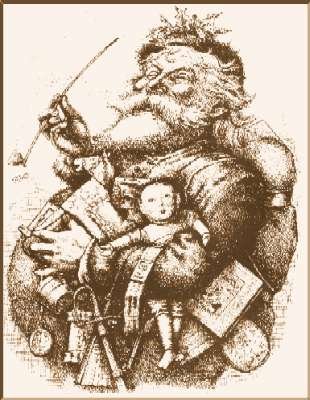 |
there is actually more to the Santa Claus to Jesus relationship than just the stories associated with the blessed day.
St. Nicholas (or Nicolas) was a generous Bishop from the fourth century who became known for acts of philanthropy. Nicholas's parents died when he was still young, leaving him a relatively comfortable fortune. However, he set out to be a Monk, and was not allowed to have money or earthly possessions. He helped to solve that problem by finding those in need of help. In one early instance, Nicholas assisted a poor farmer out with dowries when the farmer's three daughters were set to be married, the dowry being an expectation for them to even have a potential beau interested and an alternative to their being sold into slavery. In the middle of the night, he left a hefty bag of coins in the oldest daughter's room to help solve the farmer's woes. She was soon married. He then left a second bag in the middle daughter's room, and she was soon married as well. As the story goes (substantiation is tricky here) Nicholas tried to leave a bag of coins for the third daughter only to find all entries to the home locked. So the resourceful lad climbed up to the chimney and dropped the bag in there, where it reportedly bounced into the young maiden's shoes next to the fireplace. Since that time, the universal symbol of the pawnbroker has been of the three bags stylized as three golden balls in recognition of the exchange of money. Most of Nicholas' good deeds were executed anonymously, contributing to the legend of him not being seen when delivering gifts. After being imprisoned and tortured for many years under the realm of the ruthless Diocletian,
A 1907 sheet music cover for the Santa Claus march.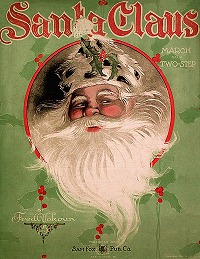 |
Nicholas was freed by Emperor Constantine, one of the founders of the Catholic Church. He eventually became a well-loved Archbishop of the Church. Nicholas was also one of the authors of the still-used Nicene creed. It was for these factors and other acts of generosity including feeding many people during times of famine that Nicholas was canonized by the Byzantine Catholic Church, even as he was still alive, as the patron saint of children, sailors, marriageable maidens and pawnbrokers. He died on December 6, which is still celebrated in honor of the memory of this remarkable individual.
The legend of the generous man leaving gifts at night sprung up separately from St. Nicolas, but the two merged in the seventeenth century. It was linguistic aberration during migration to the American colonies that the Dutch
St. Nicholas shifted to
Saint NiClaus, then
Sinter Klass, and then, because the
Sinter was difficult for children to pronounce, to
Santa Claus. Still, there were difficulties in spreading his story in English speaking countries since the celebration of Christmas (not the recognition) was banned in England and the Colonies under Puritan rule from 1642 to the 1660s, and often looked on as frivolity for the next century. It was the 1823 anonymous publication of
An Account of A Visit From St. Nicholas by
Clement Clarke Moore (authorship disputed) that set part of the legend in stone, even if the visual image was still somewhat nebulous. The poem introduced to the Western world the flying reindeer, the association of elves (St. Nicholas being one), the German tradition of hanging stockings, and at least some of the specifications of the old man's physique. Moore based his work on descriptions from an earlier work by noted author
Washington Irving in his satirical
A History of New York which included some detail of the exploits of the Dutch-based
A Haddon Sundblom Coca-Cola Santa Claus from the 1930s. |
Sancte Claus. It was Moore who first combined the Dutch legend with Christmas Eve. Even though the connection was now made, there was work to be done on Santa's perceived appearance.
In a time before there were funny papers or daily/weekly comics as we know them, there was an emerging movement of political cartoonists. The art of political satire through art goes back to before the printing press, but with more newspapers syndicated nationally, such as Frank Leslie's Illustrated, the political cartoon was fast growing in popularity. Leading the charge was Thomas Nast, who among others, helped clean out New York's notorious Tammany Hall dynasty in the 1880's. Nast was respected both for his drawings and content, often by those he satirized. In one of his more placid moments early in his career, around 1862 to 1863, he helped to bring Santa Claus of 1823 into a recognizable shape, close to what is accepted now in English speaking countries. He also helped visualize the sleigh and reindeer, as well as establish Santa Claus as the maker of the toys he delivered as well. The distribution of Nast's cartoons influenced most images from this time on until Haddon Sundblom created a long running series of Santa advertisements for Coca Cola starting in the early 1930s (certainly the colors were right for Coke's advertising). Throughout the Ragtime era, this was the imagery of Saint Nicholas that was conjured up by children of all ages and widely used in magazines and newspapers. In the 1980s the Vatican reconfigured their positions on a number of individuals who had Sainthood status, and made the decision to declare that Nicholas was not a true Saint, perhaps in part to distance themselves from the association with Santa Claus. This in no way should diminish the memory life of this generous man, a contention reinforced by many associated with the church who differ in that official opinion. Just the same, while so much emphasis has been put on the reincarnation of Nicholas as Santa over the past century, is there anybody inspired enough out there who can now do the same or better for the child who started it all? Let's pray for that to happen.
HE  RIGIN OF THE
  INTH
INTH  EINDEER
Although much of the origin of the famous crimson-beaked mammal leading Santa's sleigh is well-known to many around the world, there are parts of the story which are often overlooked.
Rudolph evolved out of a very sad situation.
Before Rankin-Bass - The original story by Robert May.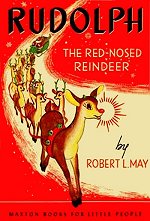 |
Robert May of Chicago, Illinois, was a copywriter for the now defunct Chicago-based
Montgomery Ward department store chain, providing text for catalogs and newspaper ads. He had been picked on often as a child, and while many of his friends had gone on to prestigious careers he was barely surviving on his meager salary. In 1936 his wife
Evelyn Hermann contracted cancer. By November of 1938 she was very ill and spent most of her time in bed or on the couch. Their 4 year-old daughter
Barbara asked her daddy one evening why her mommy was so different from other mommies. Robert understood how dejected she must have felt, having gone through childhood pain himself. So he started to tell her a story he had been working on by a request from his manager for an anticipated handout booklet for Christmas. It was based in part on
The Ugly Duckling and revolved around a reindeer with a red nose who lived in a colony with many other reindeer. The younger bucks did not accept this particular reindeer's abnormality and routinely shunned him. Still, he had a loving home and was fairly well adjusted. Then one Christmas Eve when the fog was thick and the weather foul, Santa Claus came to the deers' village and Rudolph's home to deliver presents. He saw how this young reindeer's glowing red nose cut through the fog, and hoping to avoid further disasters that had plagued him throughout the evening, including a close brush with an airplane, he employed the young hero to help him with deliveries for the remainder of the trip. This made the youngster a local celebrity immediately, and he became well-loved and the stuff of legend.
Rudolph as perceived by
Max Fleischer in 1948.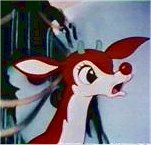 |
Barbara loved the story and asked her daddy to tell it many more times until he finally got the details as he wanted them, expanding it a little each time. Among the details was the name. He started with
Rollo, which was too stereotypically jolly. Then he tried
Reginald, but that seemed rather stuffy. Then he chanced upon the unusual
Rudolph, and it stuck.
May was in the process of turning the story into a poem for the handout, using Clement Moore's The Night Before Christmas as a template. In constant grief, and clinging to Barbara for comfort, he soon finished the story (not in time for the 1938 season), binding it as Barbara's gift on Christmas morning. At a company holiday gathering later in the week, May reluctantly attended at the request of his associates. He read the poem to them and they responded favorably. While the promotions department thought to use it the following year, they were tenuous on this topic since the red-nosed feature could represent drunkenness, an unwanted image. Denver Gillen, who did artwork for the catalogs, sketched some reindeer at the local zoo giving them the scarlet proboscis. Based on his images the executives gave the go-ahead. Evelyn H. May passed on in Chicago on July 28, 1939. It was that same year that Montgomery Ward used Rudolph The Red-Nosed Reindeer: The Day Before Christmas as a handout the following Christmas, issuing some 2.6 million copies in its debut year of 1939.
Unfortunately for May, his work was the property of Montgomery Ward, who eventually printed a total of 6 million copies through 1946, including a paper-conserving pause during World War II. There was lots of Rudolph-related merchandise offered by the store as well. The creator did not prosper in any way initially, and was still paying medical bills from his wife's cancer. Finally in 1946 May was given the rights to the work by his employer, ensuring him some well-deserved financial security.
A 1949 printing of the
famous song.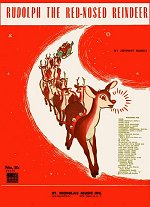 |
He tasked his brother-in-law,
Johnny Marks, to adapt the story into a children's song
(click for lyrics). Not much remained of the original story, but it was short and to the point. They shopped the piece around to many recording artists, including
Bing Crosby,
Dinah Shore,
Perry Como and others. It was used with a chorus in the 1948
Max Fleischer Technicolor cartoon short based on May's story (currently available on DVD with the 1951 version of
Scrooge) which was also released as a record on an independent label. As an afterthought they sent a copy to the well-established "Singing Cowboy,"
Gene Autry, who was as resistant as all the other artists. It was Autry's wife, Ina, who insisted that Gene record the piece for the Christmas sides he was working on in August of 1949. At the end of a very long recording session for three other holiday pieces, Autry decided to give it a try, and after a couple of rehearsals he recorded the song in one take. That one take still lives with us more than half a century later, and helped make Autry famous across multiple music genres. It is the third largest selling recording of all time behind Crosby's
White Christmas and
Elton John's Candle in the Wind 1997. Autry's recording became so famous that the opening of the Fleischer cartoon was re-edited to accommodate it. Marks went on to write additional pieces for the well-known
Rankin-Bass 1964 clay-animated special of the same name featuring folk singer
Burl Ives. In fact,
Holly Jolly Christmas was a huge hit for Ives for many years. Since that time there have been numerous other Christmas specials about the flying night-light, including a 1998 animated feature, giving Rudolph more or less permanent stature in the accumulative secular literature about Christmas.
Rudolph the Red-Nosed Reindeer song Copyright ©1949/1975 by Johnny Marks.








 Loading Page. Please Wait...




 Click here for more space
  Click here to expand menu